
States Face Another Challenge With Medicaid Work Rules: Staffing Shortages

(Moment/Getty Images)
Katie Crouch says calling her stateā€™s Medicaid agency to get information about her benefits can feel like a series of dead ends.
ā€œThe first time, itā€™ll ring interminably. Next time, itā€™ll go to a voicemail that just hangs up on you,ā€ said the 48-year-old, who lives in Delaware. ā€œSometimes youā€™ll get a person who says theyā€™re not the right one. They transfer you, and it hangs up. Sometimes, it picks up and thereā€™s just nobody on the line.ā€
She spent months trying to figure out whether her Medicaid coverage had been renewed. As of late March, she hadnā€™t been reapproved for the year for the state-federal program, which provides health insurance for people with low incomes and disabilities.
Crouch, who suffered a debilitating brain aneurysm a decade ago, also has Medicare, which covers people who are 65 or older or have disabilities. Medicaid had been paying her monthly Medicare deductibles of $200, but sheā€™d been on the hook for them for the past three months, straining her familyā€™s fixed income, she said.
Crouchā€™s challenges with Delawareā€™s Medicaid call center arenā€™t unique. State Medicaid agencies can struggle to keep enough staff to help people sign up for benefits and field calls from enrollees with questions. A shortage of such workers can keep people from fully using their benefits, health policy researchers said.
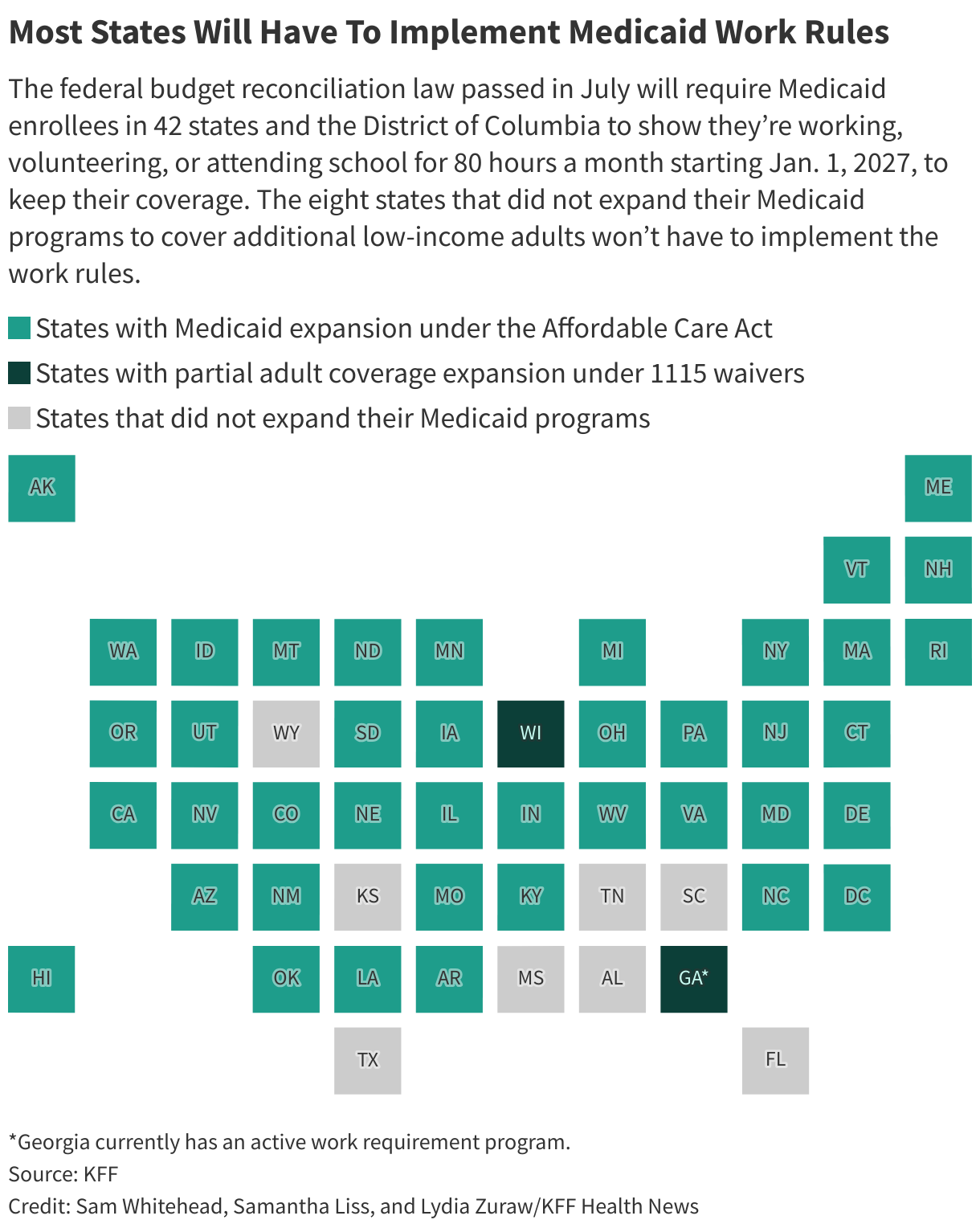
Now, congressional Republicansā€™ One Big Beautiful Bill Act, which President Donald Trump signed into law last summer, will soon demand more from staff at state agencies in places where lawmakers expanded Medicaid to more low-income adults ā€” nearly all states and the District of Columbia.
Under the law, which is expected to reduce Medicaid spending by almost $1 trillion over the next eight years, these staffers will have to not only determine whether millions of enrollees meet the programā€™s new work requirements but also verify more frequently that they qualify for the program ā€” every six months instead of yearly.
Ńī¹óåś“«Ć½Ņ•īl Health News reached out to agencies that will need to stand up the work rules, and many said theyā€™ll need additional staff.

The mandates will put extra strain on an already-stressed workforce, potentially making it harder for enrollees like Crouch to get basic customer service. And many could lose access to benefits theyā€™re legally entitled to, said consumer advocates and health policy researchers, some of them with direct experience working at state agencies.
States are already ā€œstruggling significantly,ā€ said Jennifer Wagner, the director of Medicaid eligibility and enrollment at the Center on Budget and Policy Priorities and a former associate director of the Illinois Department of Human Services. ā€œThere will be significant additional challenges caused by these changes.ā€
Long Wait Times for Help
Republicans argue the Medicaid changes, which will take effect Jan. 1, 2027, in most states, will encourage enrollees to find jobs. Research on other Medicaid work requirement programs has found little evidence they increase employment.
The Congressional Budget Office would cause more people to lose health coverage by 2034 than any other part of the GOP budget law. It said last year more than 5 million people could be affected.
Many states donā€™t have the staff to process Medicaid applications or renewals quickly, said consumer advocates and researchers.
The Centers for Medicare & Medicaid Services tracks whether states can handle the most common type of benefit application within a 45-day window.
In December, about 30% of all Medicaid and Childrenā€™s Health Insurance Program, or CHIP, applications in Washington, D.C., and Georgia to process. More than a quarter took that long in Wyoming. In Maine, 1 in 5 applications missed that deadline.
CMS began publicly sharing state Medicaid call center data in 2023, revealing a taxed system, researchers and consumer advocates said.
In Hawaii, people waited on the phone for more than three hours in December. They waited for nearly an hour in Oklahoma, and more than an hour in Nevada.
In 2023, state Medicaid agencies began making sure enrollees who were protected from being dropped from the program during the covid pandemic still qualified for coverage. That Medicaid unwinding process didnā€™t go well in many states, and lost their benefits.
Health policy researchers and consumer advocates say rolling out the new Medicaid rules will be a bigger challenge. The Medicaid work rules will require extensive IT system changes and training for workers verifying eligibility on a tight timeline.
ā€œIt is a much larger scale of administrative complexity,ā€ said Sophia Tripoli, senior director of policy at Families USA, a health care consumer advocacy organization.
After months of trying to get someone on the phone, Crouch said, she finally got answers to questions about her Medicaid benefits after writing to the office of U.S. Rep. Sarah McBride (D-Del.). McBrideā€™s office contacted the stateā€™s Medicaid agency, which eventually called with an update, Crouch said.
Crouch didnā€™t qualify for Medicaid after all. She said that had never come up in two years of interactions with the state.
ā€œIt makes absolutely no senseā€ that the state never realized she shouldnā€™t have been on the program, Crouch said.
Delawareā€™s Medicaid agency didnā€™t respond to requests for comment on Crouchā€™s situation.
States Short-Staffed for Medicaid
Some states told Ńī¹óåś“«Ć½Ņ•īl Health News in late March that theyā€™ll need more staff to roll out the work rules effectively.
Idaho said it has 40 eligibility worker vacancies. New York estimated it will need 80 new employees to handle the additional administrative work, at a cost of $6.2 million. Pennsylvania said it has nearly 400 open positions in county human services offices in the state. Indianaā€™s Medicaid agency has 94 open positions. Maine wants to hire 90 additional staffers, and Massachusetts wants to hire 70 more.
As of early March, Montana had filled 39 of 59 positions state officials projected it would need. The state still plans to roll out the rules early, starting July 1, despite its long struggle with system backlogs that applicants said have delayed benefits.
Missouriā€™s social services agency has been cutting staff and has 1,000 fewer front-line workers than it did roughly a decade ago ā€” with more than double the number of enrollees in Medicaid and the Supplemental Nutrition Assistance Program, or SNAP, according to comments Jessica Bax, the agency director, made in November.
ā€œThe department thought that there would be a gain in efficiency due to eligibility system upgrades,ā€ Bax said. ā€œMany of those did not come to fruition.ā€
States could have a hard time finding people interested in taking those jobs, which require months-long training, can be emotionally challenging, and generally offer low pay, said Tricia Brooks, a researcher at the Georgetown University Center for Children and Families.
ā€œThey get yelled at a lot,ā€ said Brooks, who formerly ran New Hampshireā€™s Medicaid and CHIP customer service program. ā€œPeople are frustrated. Theyā€™re crying. Theyā€™re concerned. Theyā€™re losing access to health care, and so sometimes itā€™s not an easy job to take if itā€™s hard to help someone.ā€
States are paying government contractors millions of dollars to help them comply with the new federal law.
Maximus, a government services contractor, provides eligibility support, such as running call centers, in 17 states that expanded Medicaid and interacts with nearly 3 in 5 people enrolled in the program nationally, according to the company.
During a February earnings call, company leadership said Maximus can charge based on the number of transactions it completes for enrollees, independent of how many people are enrolled in a stateā€™s Medicaid program.
Maximus has ā€œno one-size-fits-all approachā€ to the services it offers or the way it charges for those services, spokesperson Marci Goldstein told Ńī¹óåś“«Ć½Ņ•īl Health News.
The company, which reported bringing in $1.76 billion in 2025 from the part of its business that includes Medicaid work, expects that revenue to continue to grow, even as people fall off the Medicaid rolls, ā€œbecause of the additional transactions that will need to take place,ā€ David Mutryn, Maximusā€™ chief financial officer and treasurer, said during the earnings call.
Losing Medicaid health coverage isnā€™t just an inconvenience, since many people enrolled in the program probably donā€™t make enough money to pay for health care on their own and may not qualify for financial help for Affordable Care Act coverage, said Elizabeth Edwards, a senior attorney with the National Health Law Program.
People could be unable to afford medications or get essential care, which could lead to ā€œdevastatingā€ health impacts, she said.
ā€œThe human stakes of this are peopleā€™s lives,ā€ she said.
Ńī¹óåś“«Ć½Ņ•īl Health News correspondents Katheryn Houghton and Samantha Liss contributed to this report.


