

LOS ANGELES — For 26-year-old Paulina Ruiz, having legal immigration status is about more than going to school or holding a job. It’s about staying healthy.
The University of California-Los Angeles graduate, whose parents brought her from Mexico to the U.S. illegally two decades ago, has cerebral palsy, a neurological condition diagnosed shortly after birth.
In the past, Ruiz said, she relied on emergency rooms for her health care and rarely could see specialists. She developed kidney and back problems after years of inconsistent medical care and using an inappropriate wheelchair.


Paulina Ruiz, who has cerebral palsy, said losing her legal immigration status could mean losing her health coverage and access to doctors. Ruiz is on Medi-Cal, which helps cover some of the costs of her medical care. (Courtesy of Paulina Ruiz)
But in 2012, she qualified for the federal Deferred Action for Childhood Arrivals (DACA) program, which temporarily protected her from deportation. In California, that meant she could get Medi-Cal, California’s version of the Medicaid insurance program for low-income Americans, and regularly see a doctor.
°ճó±ðÌý°հù³ܳ¾±èÌý²¹»峾¾±²Ծ±²õ³ٰù²¹³پ±´DzÔ’sÌý³¦´DzԳٰù´DZ¹±ð°ù²õ¾±²¹±ôÌý the DACA program does more than put nearly 800,000 “Dreamers” in fear of deportation and losing their jobs. It threatens the health care of thousands of young adults like Ruiz, who either have job-based insurance or whose incomes qualify them for Medicaid in California and several other states.
“I am very upset,” said Ruiz, who organizes for the Coalition for Humane Immigrant Rights of Los Angeles and lives near the city. “I don’t know what’s going to happen to my health.”
The decision is set to take effect in six months, unless Congress comes up with an alternative plan. Trump has said the program, started under President Obama in 2012, rewards by taking their jobs and depressing wages, a claim dispute. Attorney General Jeff Sessions said Tuesday that the program was because it was a unilateral executive action on a proposal that had been repeatedly rejected by Congress.
Trump, who has suggested he has conflicting sentiments about the program, left open the door for Congress to change it. “I have a love for these people, and hopefully now Congress will be able to help them and do it properly,” he said, according to But the newspaper noted that he did not call for bipartisan legislation to restore its protections.
The program allows immigrants between the ages of 16 and 31 who were brought to the United States illegally as children to receive work permits and temporary protection from deportation. Those who qualified were explicitly barred from receiving federal health benefits through Medicaid, Obamacare exchanges or other programs.
Many DACA recipients now have jobs with health insurance. In addition, California, New York, Massachusetts, Minnesota and the District of Columbia have used their own money to cover low-income Dreamers through Medicaid, according to Tanya Broder, a Berkeley, Calif.-based senior staff attorney for the National Immigration Law Center.

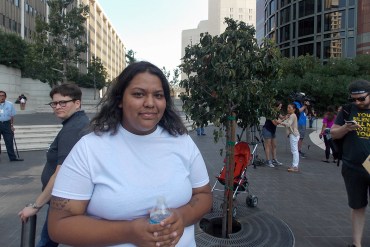
Maria Garcia, 22, said she was able to get a job as a receptionist at a Los Angeles hotel because of the DACA program. The job also came with health insurance, which helped cover physical therapy from a knee injury. She fears getting fired and being unable to pay for her own health insurance and medical care. (Anna Gorman/KHN)
´¡²ÔÌý people qualify for DACA in California. There are an estimated 220,000 DACA recipients in California, the largest number in the country. Those who meet — 138 percent of the federal poverty level or $33,534 for a family of four — can qualify for coverage under the state’s “Permanently Residing in the United States under Color of Law” .
That coverage is now in question. In California, those at risk of losing Medicaid are 19 and older, because the state under a separate law decided to cover all low-income children, regardless of immigration status, through age 18. That decision was not connected to the DACA program.
With the federal government’s action, “nobody will lose coverage in the Medi-Cal program immediately,” said Ronald Coleman, director of government affairs for the California Immigrant Policy Center, an immigrant advocacy group. But Coleman worries about what happens after March 5, when DACA’s protections will end — unless Congress takes action to protect the program.
The Department of Health Care Services, which oversees Medi-Cal, could not provide a comment on Tuesday, a spokeswoman said.
Marielena Hincapié, executive director of the National Immigration Law Center, told reporters in a conference call on Tuesday that she expects DACA recipients to start losing their job-based health insurance. Hincapié said she is particularly concerned about the effect of the president’s decision on the mental health of DACA recipients.
“The need for mental health services will only be greater,” she said.

Jocelin Reyes, 19, said having protection from deportation relieved her fears and anxieties. But now, the University of California-Santa Barbara student said, “the fear has tripled.” (Anna Gorman/KHN)
At a protest in downtown Los Angeles Tuesday against the Trump administration’s decision, Jocelin Reyes made a similar point. She said DACA’s protections had helped put some young immigrants’ fears to rest, as they were able to get jobs, attend college or graduate school and come out of hiding.
“A lot of people don’t understand how much fear we had” about being deported, said Reyes, 19, who is about to start school at the University of California-Santa Barbara. “Now that fear has tripled.”
Another demonstrator, DACA recipient Maria Garcia, 22, said that losing her job as a hotel receptionist would mean the end of her job-based health insurance — coverage she relies on for physical therapy for a knee injury and any time she gets sick.
“If they take away my DACA, I’ll get fired,” she said. “And then what will I do for health insurance?”
State Sen. Ricardo Lara (D-Bell Gardens) said ending DACA would only hurt “the well-being of these American children who have played by the rules.” And they could end up having to go to costly emergency rooms for medical care.
Lara, who led the charge to get , said one possible solution in California would be to increase the age limit for Medi-Cal coverage for kids from 18 to 26.
“We have to answer this call to ensure that our DACA students and workers are not pushed aside,” he said.
The California Medical Association said that terminating DACA could indeed hurt the health care workforce.
“Our nation’s health care system has the largest percentage of foreign-born and foreign-trained workers of any industry in the country. Already facing a national shortage of physicians and other health care professionals, revoking DACA could also undermine patient care and disrupt medical schools and hospitals for decades to come,” said California Medical Association President Ruth E. Haskins in a statement.
Ana B. Ibarra contributed to this report.
This story was produced by , which publishes , an editorially independent service of the .
KHN’s coverage in California is funded in part by .