The care was ordinary. A hospital in Modesto, California, treated a 30-year-old man for shoulder and back pain after a car accident. He went home in less than three hours.
The bill was extraordinary. Sutter Health Memorial Medical Center charged $44,914 including an $8,928 鈥渢rauma alert鈥� fee, billed for summoning the hospital鈥檚 top surgical specialists and usually associated with the most severely injured patients.
The case, buried in the records of a 2017 trial, is a rare example of a courtroom challenge to something billing consultants say is increasingly common at U.S. hospitals.
Tens of thousands of times a year, hospitals charge enormously expensive trauma alert fees for injuries so minor the patient is never admitted.
In Florida alone, where the number of trauma centers has exploded, hospitals charged such fees more than 13,000 times in 2019 even though the patient went home the same day, according to a KHN analysis of state data provided by Etienne Pracht, an economist at the University of South Florida. Those cases accounted for more than a quarter of all the state鈥檚 trauma team activations that year and were more than double the number of similar cases in 2014, according to an all-payer database of hospital claims kept by Florida鈥檚 Agency for Health Care Administration.
While false alarms are to be expected, such frequent charges for little if any treatment suggest some hospitals see the alerts as much as a money spigot as a clinical emergency tool, claims consultants say.
鈥淪ome hospitals are using it as a revenue generator,鈥� Tami Rockholt, a registered nurse and medical claims consultant who appeared as an expert witness in the Sutter Health car-accident trial, said in an interview. 鈥淚t鈥檚 being taken advantage of鈥� and such cases are 鈥渨ay more numerous鈥� than a few years ago, she said.
Hospitals can charge trauma activation fees when a crack squad of doctors and nurses assembles after an ambulance crew says it鈥檚 approaching with a patient who needs trauma care. The idea is that life-threatening injuries need immediate attention and that designated trauma centers should be able to recoup the cost of having a team ready 鈥� even if it never swings into action.
Those fees, which can exceed $50,000 per patient, are billed on top of what hospitals charge for emergency medical care.
鈥淲e do see quite a bit of non-appropriate trauma charges 鈥� more than you鈥檇 see five years ago,鈥� said Pat Palmer, co-founder of Beacon Healthcare Costs Illuminated, which analyzes thousands of bills for insurers and patients. Recently 鈥渨e saw a trauma activation fee where the patient walked into the ER鈥� and walked out soon afterward, she said.
The portion of Florida trauma activation cases without an admission rose from 22% in 2012 to 27% last year, according to the data. At one Florida facility, Broward Health Medical Center, there were 1,285 trauma activation cases in 2019 with no admission 鈥� almost equal to the number that led to admissions.
鈥淭rauma alerts are activated by EMS [first responders with emergency medical services], not hospitals, and we respond accordingly when EMS activates a trauma alert from the field,鈥� said Jennifer Smith, a Broward Health spokesperson.
Florida regulations allow hospitals themselves to declare an 鈥渋n-hospital trauma alert鈥� for 鈥減atients not identified as a trauma alert鈥� in the field, according to by the Florida Department of Health.
At some hospitals, few patients whose cases generate trauma alerts are treated and released the same day.
At Regions Hospital, a Level I trauma center in St. Paul, Minnesota, patients who are not admitted after a trauma team alert are 鈥渧ery rare鈥� 鈥� 42 of 828 cases last year, or about 5%, said Dr. Michael McGonigal, the center鈥檚 director, who blogs at 鈥�.鈥�
鈥淚f you鈥檙e charging an activation fee for all these people who go home, ultimately that鈥檚 going to be a red flag鈥� for Medicare and insurers, he said.
In the Sutter case in Modesto, the patient sued a driver who struck his vehicle, seeking damages from the driver and her insurer. Patient 鈥渓ooks good,鈥� an emergency doctor wrote in the records, which were part of the trial evidence. He prescribed Tylenol with hydrocodone for pain.
鈥淚f someone is not going to bleed out, or their heart is not going to stop, or they鈥檙e not going to quit breathing in the next 30 minutes, they probably do not need a trauma team,鈥� Rockholt said in her testimony.
Like other California hospitals with trauma center designations, Sutter Health Memorial Medical Center follows 鈥渃ounty-designated criteria鈥� for calling an activation, said Sutter spokesperson Liz Madison: 鈥淭he goal is to remain in position to address trauma cases at all times 鈥� even in the events where a patient is determined healthy enough to be treated and released on the same day.鈥�
Trauma centers regularly review and revise their rules for trauma team activation, said Dr. Martin Schreiber, trauma chief at Oregon Health & Science University and board chair at the Trauma Center Association of America, an industry group.
鈥淚t is not my impression that trauma centers are using activations to make money,鈥� he said. 鈥淎ctivating patients unnecessarily is not considered acceptable in the trauma community.鈥�
Hospitals began billing trauma team fees to insurers of all kinds after Medicare authorized them for cases in which hospitals are notified of severe injuries before a patient arrives. Instead of leaving trauma team alerts to the paramedics, hospitals often call trauma activations themselves based on information from the field, trauma surgeons say.
Reimbursement for trauma activations is complicated. Insurers don鈥檛 always pay a hospital鈥檚 trauma fee. Under rules established by Medicare and a committee of insurers and health care providers, emergency departments must give 30 minutes of critical care after a trauma alert to be paid for activating the team. For inpatients, the trauma team fee is sometimes folded into other charges, billing consultants say.
But, on the whole, the increase in the size and frequency of trauma team activation fees, including those for non-admitted patients, has helped turn trauma operations, often formerly a financial drain, into profit centers. In recent years, hundreds of hospitals have sought trauma center designation, which is necessary to bill a trauma activation fee.
鈥淭here must have been a consultant that ran around the country and said, 鈥楬ey hospitals, why don鈥檛 you start charging this, because you can,鈥欌�� said Marc Chapman, founder of , which challenges large hospital bills for auto insurers and other payers. 鈥淚n many of those cases, the patients are never admitted.鈥�
The national number of Level I and Level II trauma centers, able to treat the most badly hurt patients, grew from 305 in 2008 to 567 last year, according to the American College of Surgeons. Hundreds of other hospitals have Level III or Level IV trauma centers, which can treat less severe injuries and also bill for trauma team activation, although often at lower rates.
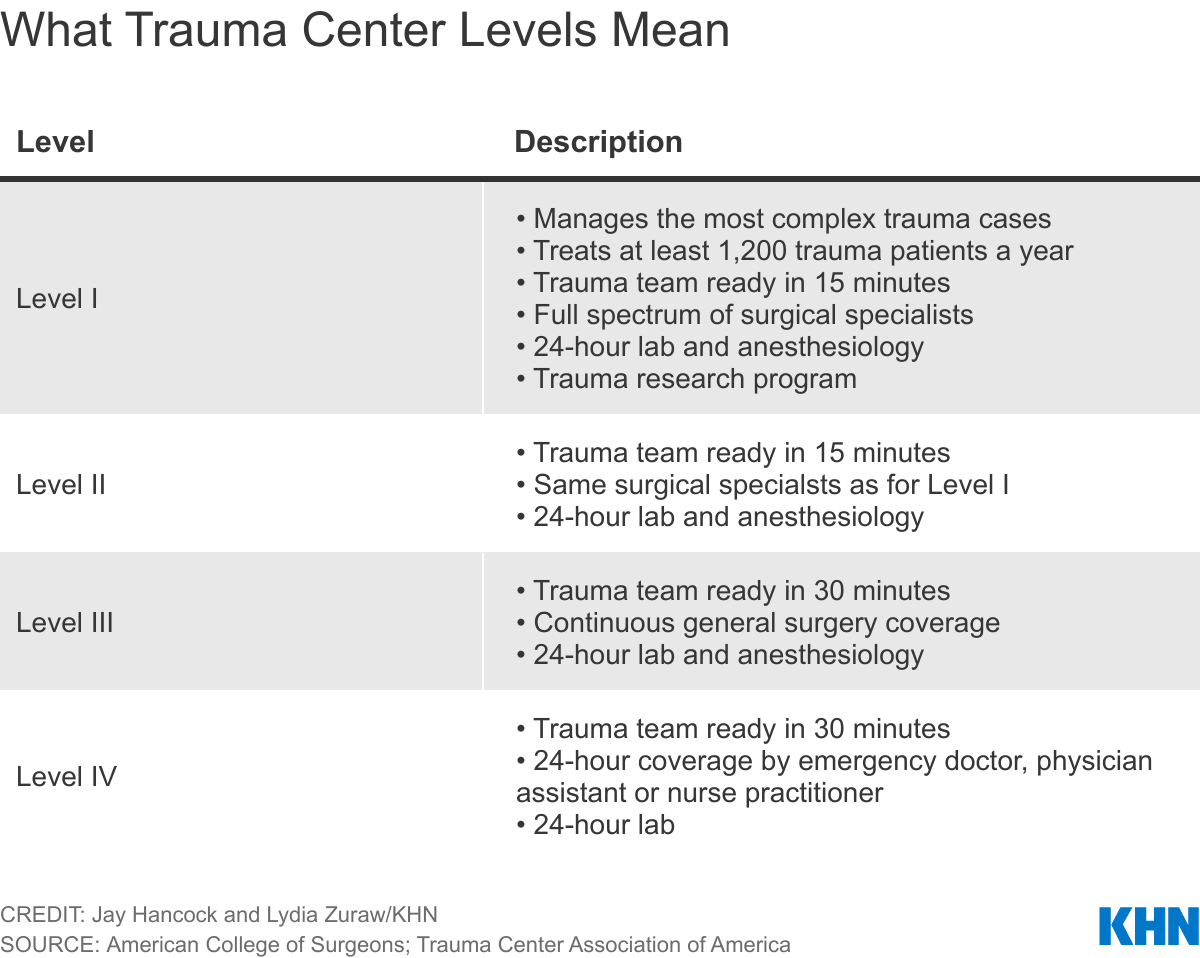
What Trauma Center Levels Mean
CREDIT: Jay Hancock and Lydia Zuraw/KHN
; Trauma Center Association of America
Emergency surgeons say they walk a narrow path between being too cautious and activating a team unnecessarily (known as 鈥渙vertriage鈥�) and endangering patients by failing to call a team when severe injuries are not obvious.
Often 鈥渨e don鈥檛 know if patients are seriously injured in the field,鈥� said Dr. Craig Newgard, a professor of emergency medicine at Oregon Health & Science University. 鈥淭he EMS providers are using the best information they have.鈥�
Too many badly hurt patients still don鈥檛 get the care they need from trauma centers and teams, Newgard argues.
鈥淲e鈥檙e trying to do the greatest good for the greatest number of people from a system perspective, recognizing that it鈥檚 basically impossible to get triage right every time,鈥� he said. 鈥淵ou鈥檙e going to take some patients to major trauma centers who don鈥檛 really end up having serious injury. And it鈥檚 going to be a bit more expensive. But the trade-off is optimizing survival.鈥�
At Oregon Health & Science, 24% of patients treated under trauma alerts over 12 months ending this spring were not admitted, Schreiber said.
鈥淚f this number gets much lower, you could put patients who need activation at risk if they are not activated,鈥� he said.
On the other hand, rising numbers of trauma centers and fees boost health care costs. The charges are passed on through higher insurance premiums and expenses paid not just by health insurers but also auto insurers, who often are first in line to pay for the care of a crash victim.
Audits are uncommon and often the system is geared to paying claims with little or no scrutiny, billing specialists say. Legal challenges like the one in the Sutter case are extremely rare.
鈥淢ost of these insurers, especially auto insurance, do not look at the bill,鈥� said Beth Morgan, CEO of Medical Bill Detectives, a consulting firm that helps insurers challenge hospital charges. 鈥淭hey automatically pay it.鈥�
And trauma activation charges also can hit patients directly.
鈥淪ometimes the insurance companies will not pay for them. So people could get stuck with that bill,鈥� Morgan said.
A few years ago, Zuckerberg San Francisco General Hospital charged a $15,666 trauma response fee to the family of a toddler who had fallen off a hotel bed. He was fine. Treatment was a bottle of formula and a nap. The hospital waived the fee after KHN and Vox wrote about it.
Trauma alert fatigue can add up to a nonfinancial cost for the trauma team itself, McGonigal said.
鈥淓very time that pager goes off, you鈥檙e peeling a lot of people away from their jobs only to see [patients] go home an hour or two later,鈥� he said.
鈥淪ome trauma centers are running into problems because they run themselves ragged. And there is probably unneeded expense in all the resources that are needed to evaluate and manage those patients.鈥�
杨贵妃传媒視頻 Health News is a national newsroom that produces in-depth journalism about health issues and is one of the core operating programs at KFF鈥攁n independent source of health policy research, polling, and journalism. Learn more about .